Circle:すべての企業がステーブルコインを発行できるわけではありません
原文タイトル:The Stablecoin Trap: Issuing a Stablecoin Without the Infrastructure to Run One
原著者:Kash Razzaghi、Circle
翻訳:Peggy、BlockBeats
Editor's Note: With regulatory clarity and institutional entry, stablecoins are evolving from a technical tool into a critical financial infrastructure. This article points out that issuing a stablecoin is not a simple technical choice but a long-term strategy involving trust, liquidity, and compliance capabilities. Most projects stop before scaling, and the market is naturally converging on a few mature networks. For most enterprises, the real issue is not "whether to issue a coin" but "how to use stablecoins effectively to create growth opportunities for their business."
The following is the original text:
Over the past few months, I have had recurring conversations with executives from some of the world's largest companies. They have shown a keen interest in stablecoins that enable near-instant, cross-border transactions, such as digital dollars and euros like USDC and EURC. Many of them are also pondering: Should we issue our own stablecoin?
This impulse is understandable. This market has already reached a significant scale and continues to grow steadily. By the end of 2025, the total market capitalization of stablecoins had grown from around $200 billion on January 1, 2025, to over $300 billion on December 31, 2025. USDC, issued by Circle, remains one of the core assets in this category and closed the year 2025 with a market cap exceeding $75 billion.
But before truly entering the space, every company should first ask themselves a question: Do you merely want to use stablecoins for your business, or do you intend to genuinely engage in the business of "issuing stablecoins"?
This is not a technical problem but a strategic one: Does issuing currency belong to the core of your business model?
Relatively speaking, creating a stablecoin on a blockchain is actually the easiest part. Essentially, it is just a software engineering practice: writing and deploying a blockchain-based token contract. As long as there is an engineering team, or in some cases with the help of white-label partners, a token can go live in a relatively short time. However, once the product is operational, running a stablecoin means supporting a 24/7 financial infrastructure.
To operate a trusted, regulated stablecoin – one that meets the expectations of institutions, regulators, and millions of users – one must engage in real-time reserve management across different market cycles, perform daily reconciliations with multiple banking partners, undergo independent audits, and complete compliance and regulatory reporting in multiple jurisdictions. This means building a compliance, risk management, fund management, and liquidity operation system that operates around the clock, with clear upgrade and contingency mechanisms under pressure situations and zero tolerance for errors. These capabilities are by no means something that can be "outsourced once and left unattended"; as they scale, the costs, complexity, and reputational risks will continue to accumulate and amplify.
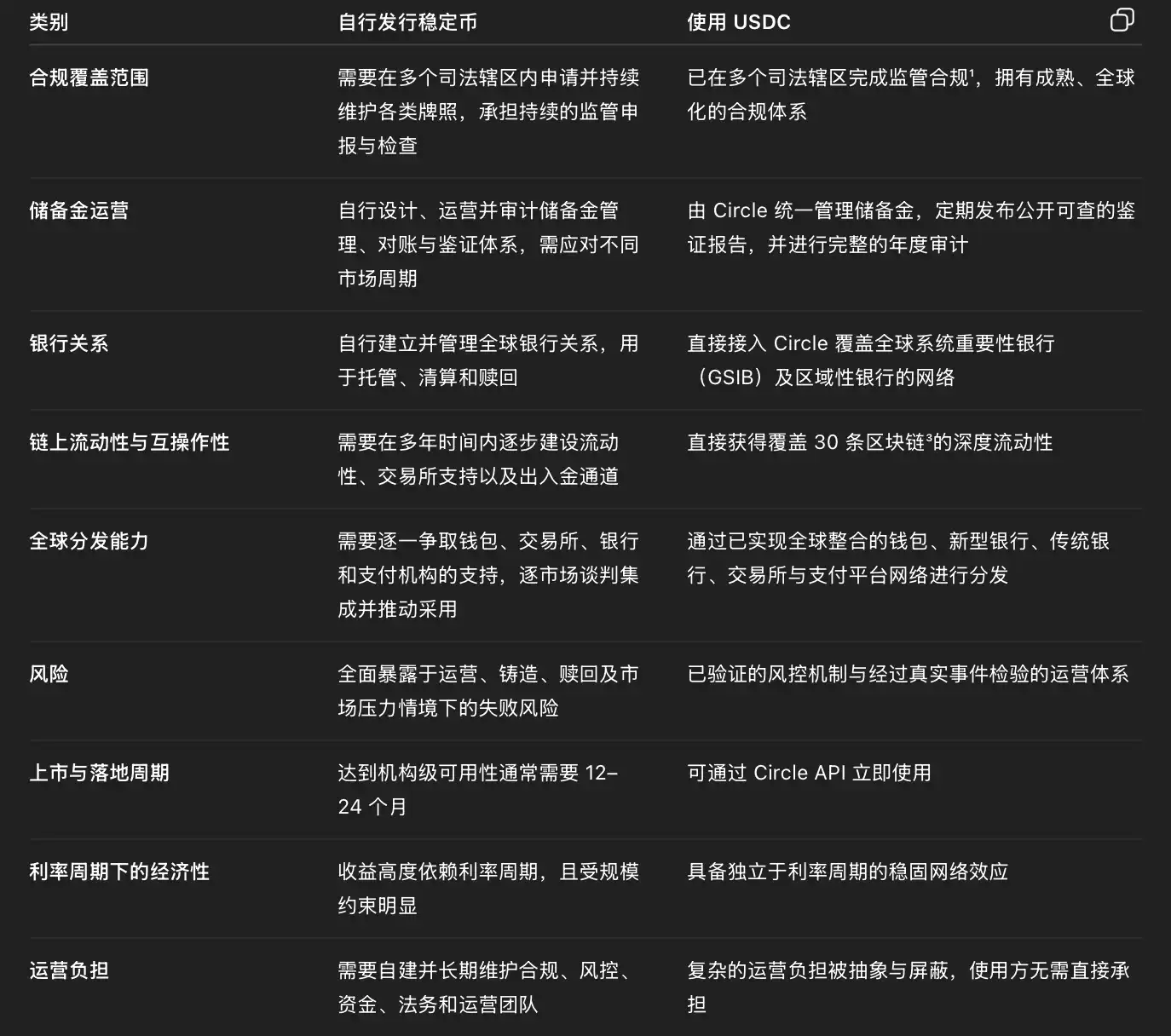
システムレベルでは、新しい閉鎖的な自前のステーブルコインごとに流動性と信頼がさらに分断されます。発行元はそれぞれが保有金、コンプライアンスシステム、償還チャネルの再構築を行い、逆に、コインがプレッシャーにさらされた際に依存する全体の深さと弾力性が弱体化します。これに対して、USDC にアクセスすることで、流動性、標準、および運用能力を最初の日から、広く採用されている統一ネットワークに統合できます。
この決定を検討している企業の上級管理職にとって、運用レベルで比較すると、これら2つの経路の違いが特に明確になります:
捷径を選ぶ誘惑
現在、金融テクノロジーカンパニーや支払事業者、暗号プロジェクトなど、多くの新参者がそれぞれのステーブルコインを探求したり直接提供したりしています。2025年までのステーブルコイン市場の成長は、規制環境の徐々に明確になることと、機関の関心の高まりを反映しています。しかし、数百ものステーブルコインがすでにオンライン上にありながら、そのうち約95% が持続的でグローバルな規模を到達していません。
一部の人々は、重い運用コストを負担せずに同様の経済的リターンを複製できると考えています。しかし、現実は決してロマンチックではありません。自己発行であれ、ホワイトラベルサービスを介してステーブルコインを発行するのであれ、信頼、流動性、および規模が生死線となる業界に足を踏み入れることになります。
時には、間違いの代償が「兆」単位で評価されることさえあります。今年初めのあるメディア報道によると、ある発行元は運用ミスによって、300兆ドルのトークンを誤って鋳造してしまいました。数分で修正されましたが、それだけで一大ニュースとなりました。別の場合には、市場が激しく揺れる中、名だたるステーブルコインが一時的にアンカリングを外れたことがあり、小さな基盤の欠陥でさえ、プレッシャー下では拡大され、段階的に伝播される可能性があることを再確認しました。
これらの出来事は、ステーブルコインが厳格な運用体制によって立ち向かうことができるかどうかは、高圧環境下での運用の慎重さにかかっていることを人々に思い出させています。市場と政策立案者が注視しています。
信頼こそが真のネットワーク効果
誰でもブロックチェーン上でトークンを作成できます。実際、すでに何千も存在しており、ほとんどが数分で鋳造され、同じくらい速く忘れ去られています。ステーブルコインの狭い市場でも、すでに300を超えるプロジェクトがオンライン上にありますが、実際にほぼすべての現実的な使用量と価値を担っているのはほんの僅かであり、95%程度が本当の成功を収めていません。
違いは技術にあるのではなく、規模と信頼にあります。ステーブルコインの真の課題は、拡大段階で始まります:異なる市場や異なるサイクルでの取引量が増加するにつれ、流動性、償還能力、コンプライアンス、およびシステムの可用性をどのように持続させるかが問われます。
数分でトークンを作成できますが、数分で信頼を構築することはできません。信頼は透明性、規模、および市場サイクル全体での一貫した償還性によって築かれ、このプロセスを通じて着実に蓄積されます。これがステーブルコイン市場が最終的に少数の発行者の手に集中する理由であり、2026年1月30日時点でUSDCの累計清算額が60兆ドルを超えた理由です。
車輪の再発明よりも協力を選択する
ほとんどの企業にとって、正しい問題は「自社のステーブルコインをどのように発行すべきか」ということではなく、「ステーブルコインをビジネスにどのように統合して新たな成長を生み出すか」ということです。
USDCとEURCを活用することで、企業は今日、デジタルドルとユーロを組み込んで、ほぼリアルタイムの決済、グローバルカバレッジ、および数十のブロックチェーン間の相互運用性を実現できます。この際、自らリザーブ管理や規制順守の複雑性を負担する必要はありません。
共に次の章を執筆する
ステーブルコイン業界は新しい段階に入っています。政策立案者がより明確な規則を策定し、機関が基準を引き上げ、市場が徐々に信頼、流動性、および規制順守を本当の防波堤と見なすシンプルなコンセンサスに収束しています。
目標は、より多くのステーブルコインを所有することではなく、より少なくてもより良いステーブルコインを所有することです。共有された流動性、透明なリザーブ、およびサイクル全体で検証されたパフォーマンスによって、現在のニーズに応えるステーブルコインです。
ステーブルコイン戦略を策定している機関にとって、最初のステップは「何を作るかを決めること」ではなく、「誰と協力して作るかを決めること」です。ビジネスを活性化するステーブルコインを望みながら、ステーブルコインの発行者となりたくない場合、時間の経過に耐えうる選択肢はクリアになっています:Circleと協力してUSDCを使用する。
BlockBeats の公式コミュニティに参加しよう:
Telegram 公式チャンネル:https://t.me/theblockbeats
Telegram 交流グループ:https://t.me/BlockBeats_App
Twitter 公式アカウント:https://twitter.com/BlockBeatsAsia
 関連記事